On My Comic Book Trials: Hits and Misses

I was never really into comic books as a child. Sure, I was into superhero video games and movies, but I never really actually read the comics. That would change when I started working. Previously at night I would watch a sports game, a movie or play a video game. But after work, I would be too tired to do any of that, but then I discovered something. Comic books were quick, exciting reads. It would take 20-30 minutes to read an issue, so that’s what I found myself doing before I went to bed. You might wonder why I didn’t read short stories instead, but to be honest I’m more of a visual person. I’ve tried reading literature, but it’s just hard for me to visualize what is being explained. For a similar reason it’s much easier for me to get into silent films than radio dramas.

During this period I would read different superhero comics series, and four would stand out in my mind: Spider-Man, X-Men, Daredevil and Fantastic Four. Three would be somewhat good, but not enough for me to keep reading on: Superman, Batman and Hulk. For the former series I was both interested in the superhero section and the more personal parts, for the latter three I would find one side much more interesting than the other.
Spiderman fan art : Spiderman

Now let’s start with my favorite superhero growing up: Spider-Man. I was certainly not disappointed with these stories, in fact reading it only affirmed that he was my favorite superhero. We have Peter Parker, a teenage loner who gets bitten by a radioactive spider and is now a superhero. This causes all sorts of issues in his life, and he often wonders if it’s worth it to continue on, but as the saying goes, with great power comes great responsibility. He decides to be selfless and put his own life at risk to save New York. There is an excellent supporting cast with both the Spider-Man side and the Peter Parker side. Friends such as Harry Osborn, Mary Jane Watson, Gwen Stacy, bully Flash Thompson, and boss J. Jonah Jameson. Then there is an excellent cast of villains: Green Goblin, Doctor Octopus, Venom, Kraven, Mysterio, Scorpion and so many more I could name.

Pin by Daniel Maldonado on X-Teams (Comics) | Marvel comics art, X men, Jim  lee

X-Men also has an intriguing premise. Stan Lee stated that he originally made them mutants because he was tired of coming up with origin stories, but this was a great idea in hindsight because them being discriminated for what they were born as turned into a very clear allegory for discrimination and the struggle for human rights in the real world. The main struggle the X-Men are faced with is making trying to prove that they are not so dangerous and that humans would benefit from accepting them. The Brotherhood of Mutants, led by Mangeto, argue that humans will never accept them and that they are better of fending for themselves (he’s often compared to Malcom X). Of course not everything goes smoothly for the X-Men themselves, it has been described as a soap opera and has a revolving door cast. I actually find the cast to be more interesting than the Avengers with iconic heroes such as Cyclops, Wolverine, Beast, Archangel, Phoenix, Gambit, Rogue, Psylocke and many, many more.

Daredevil fanart by Rindoukan on DeviantArt

I like noir influenced crime stories, so Daredevil is right up my alley. I’ll admit, I haven’t quite gotten too far yet, but I certainly find the premise very interesting so far. His main antagonist is Kingpin, not even a superhero but a mob crime boss. Matt Murdock’s stories are interesting me, as I’m also into legal drama fiction.

Fantastic Four by Stephen Byrne [Fan-Art] : comicbooks

The first family of Marvel, the Fantastic Four. It might be hard to get now, but the Fantastic Four stories were revolutionary for their time in how they dealt with the superheroes personal lives. Unlike, the Justice League, they were more like a family in how close they were. They had several struggles and disagreements, and even financial problems. In one issue they almost get evicted from their building because they can’t pay the rent! Also unusually, they do not have alter egos and are public with their identities. You also can’t forget that their superhero quests are also interesting. Their archenemy Dr. Doom is possibly the greatest villain in comics, and the Galactus Trilogy is still one of the most famous stories in comic book history.

Avengers: Infinity War - Hulk & Bruce Banner Marvel fanart | Hulk marvel,  Hulk avengers, Hulk artwork

Now I’ll get to the series I didn’t enjoy quite as much. I really should have been more into the Incredible Hulk. After all, Stan Lee said he envisioned Bruce Banner and the Hulk as a mixture of the Dr. Jekyll and Mr. Hyde and Frankenstein stories. Seeing how I like those stories (the movies at least, like I said it’s hard for me to get into written pose fiction). My main complaint with the Hulk is that he is too powerful. I think he would be better as the villain, where a group of humans go after him. That does happen, but they almost always lose. They sometimes rectify this by having fight other monsters, but I tend to prefer that approach less, just like I prefer when humans are trying to stop Godzilla then when he fights people his size.

Superman Fanart by HeartOfTheSunrise | Superman art, Superman artwork, Dc  comics art

Clark Kent has an interesting backstory. He is an alien planet, and could clearly be used as a metaphor for a struggling immigrant that the public doesn’t trust when he is going around as Superman. Unfortunately, I found Superman to be way too overpowered. He can almost anything and doesn’t have much resistance, a similar complaint I have with the Hulk. Lex Luthor is an interesting villain, but the other enemies fail to grab my attention the way he does.
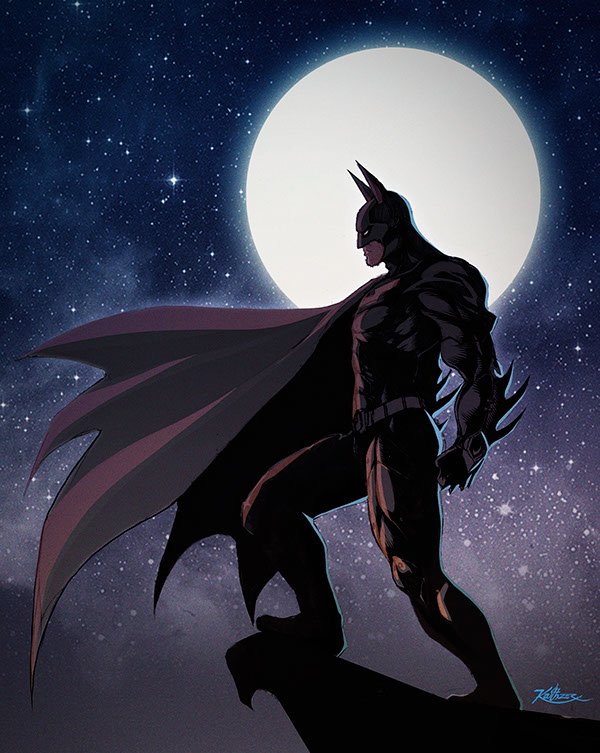
Batman Fanart Sketch on Behance

In terms of superheroes and villains, Batman might be second only to Spider-Man. As I mentioned before with Daredevil, I love pulp influenced noir crime stories and that is what Batman is. He also has a very excellent rogues gallery: Joker, Riddler, Penguin, Poison Ivy, Mr. Freeze and Bane. So what is the problem? Well it has to do mainly with Bruce Wayne himself. I do not find the story of a playboy billionaire to be the most intriguing alter ego, especially compared to Peter Parker and even Clark Kent.

So those are my thoughts so far in the series I have tried. All of them have been enjoyable, I was mainly stating the ones I enjoyed the most.
Prominent Classic Comediennes

It’s often argued that women aren’t prominent in comedy, and certainly men have mostly dominated comedy. That doesn’t mean, however, that there isn’t a history of women in comedy. In fact, during this era there were several leading roles for women in comedy films, radio and television.

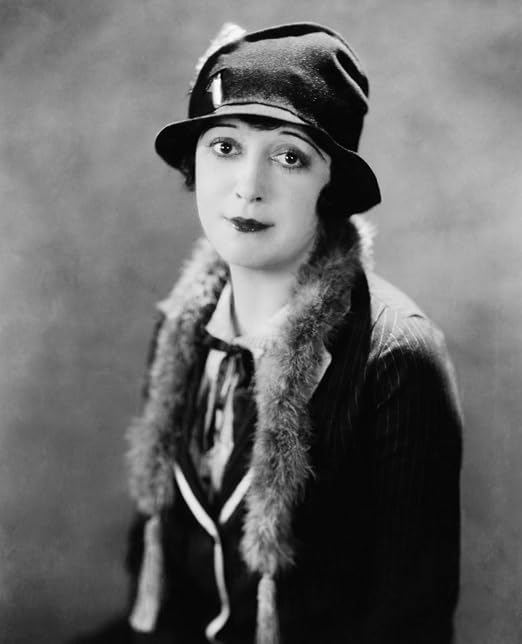
Amazon.com: Posterazzi EVCPBDMANOEC014H Mabel Normand In Hal Roach/Pathe  Comedies 1926-27 Photo Print, 8 x 10: Posters & Prints

Mabel Normand
Mabel Normand was the top comedienne of the silent era. She first gained her break in comedy when she met Mack Sennett, who set up a comedy unit in the Biograph film company. A few years later he would form Keystone with Mabel Normand as the first major star. She would work for Mack Sennett for a while, and even co-starred with other comedy greats such as Fatty Arbuckle and Charlie Chaplin. She would have a falling out with Sennett, and moved from shorts to features. Unfortunately, by the early 1920s she was involved in a series of scandals that tarnished her reputation. In 1926 she attempted another revival when she worked for Hal Roach, but this only lasted a year.

undefined

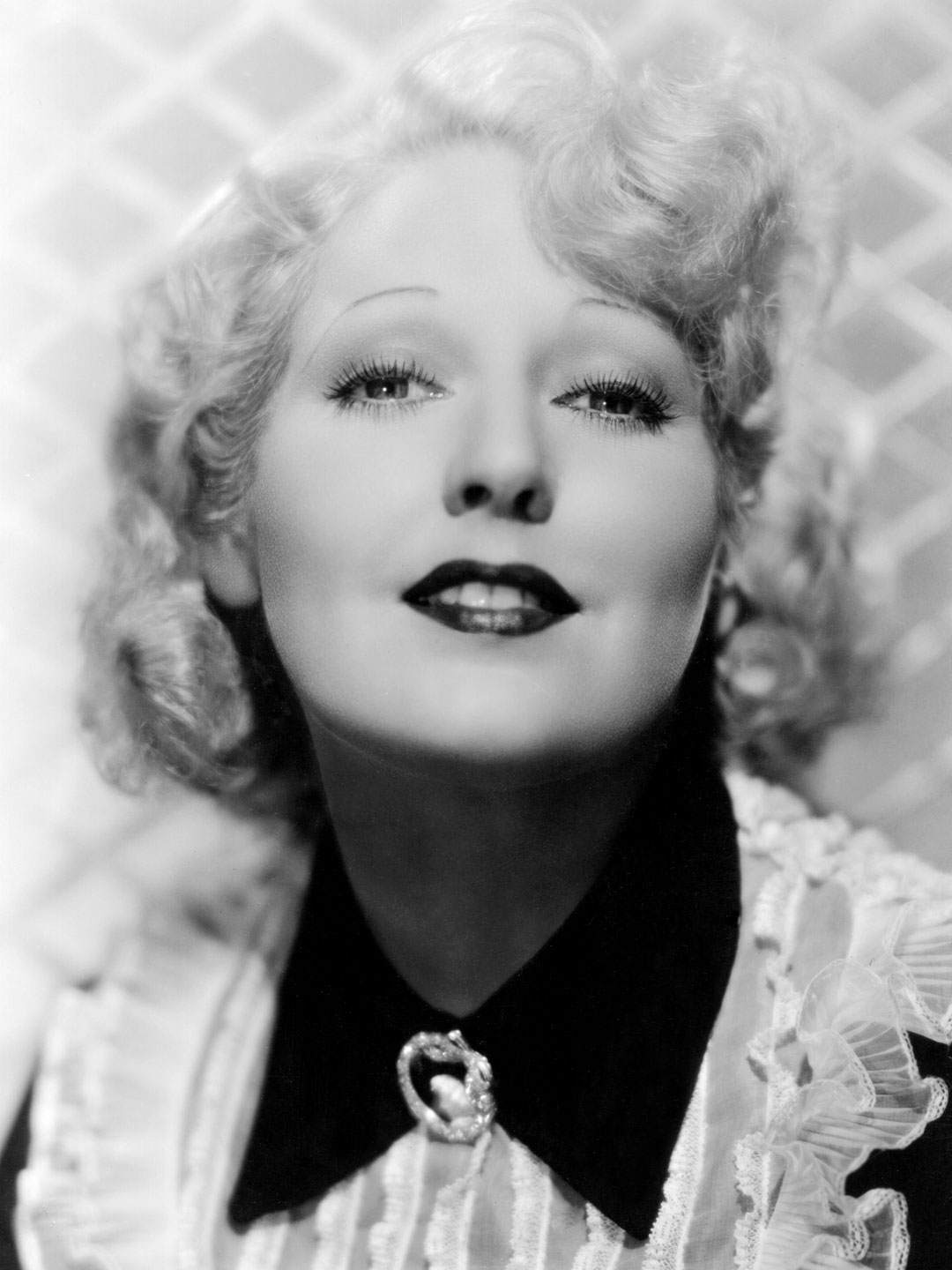
Thelma Todd
Thelma Todd became one of the most prominent supporting actresses in comedy, appearing in movies with Laurel and Hardy, the Marx Brothers, Wheeler and Woolsey and Buster Keaton. She was so popular that Hal Roach gave her a starring series. From 1931-1933 she teamed with ZaSu Pitts as a comedy duo, and then with Patsy Kelly from 1933-1935. We’ll never know what further heights she might have reached, as she would die a mysterious death when was only 29 years old.

How film goddess Carole Lombard became Hollywood's first casualty of WW II

Carole Lombard
I was considering removing Carole Lombard from this list, as most of her film roles were in dramas, but her comedy appearances were so great I couldn’t leave her off. In the late silent era, she worked for Mack Sennett in slapstick roles with Billy Bevan. Strangely, it wouldn’t be for another few years before she moved back into comedy. Then she became Queen of the Screwballs in several great films: Twentieth Century, Hands Across the Table, True Confession, Nothing Sacred, Mr. and Mrs. Smith and To Be or Not to Be. She would also die young at 33 years old. She was a great influence on Lucille Ball.

ARTICLE | "The Immortality Of Mae West" — Whidbey Island Center for the Arts

Mae West
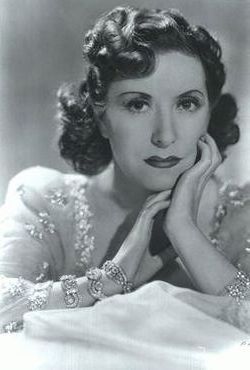
Mae West was already a stage veteran for decades by the time she made her film debut at 39 years old (older than Carole Lombard and Thelma Todd were when they died). She starred in a box office smash hits for Paramount Pictures, and extra credit has to be given to her because she was also the screenwriter in these movies. When Paramount started letting go of their talent, West was one of them. She would only sporadically make film appearances for the rest of her life after 1938.

Gracie Allen (1902-1964) - Find A Grave Memorial

Gracie Allen
Though George Burns was the main writer of the act, it was Gracie who was the bigger star during her lifetime. Her character followed “illogical logic” and she played the role so well that interviewers would later ask George Burns if she actually believed what she said (George Burns would insist that she was just playing a character). Burns and Allen would have a long lasting popularity, from vaudeville in the 1920s, to movies in the 1930s, to radio in the 1940s and finally television in the 1950s.

Ann Sothern - Wikipedia

Ann Sothern
I forgot to mention Ann Sothern earlier, so I updated this article to include her. Ann Sothern first gained fame playing a burlesque dancer in the MGM comedy series Maise that ran from 1939-1947. Then later played the lead role in the Private Secretary TV series during the 1950s. Later she had a show named after her.

Tim Torkildson's Clown Alley: Lucille Ball -- The Perfect Clown.

Lucille Ball
Lucille Ball is probably the most famous name on this list, and if somebody was to name a comedienne she might be first. She was much different from the other women comedians on this list, as she was more like a slapstick clown doing the type of the stuff that Charlie Chaplin, Harpo Marx, Laurel and Hardy and The Three Stooges usually did. After failing to make it big as a movie actress, she would achieve enormous fame as a television star, where her sitcoms would be some of the highest rated shows for two decades.

Eve Arden - Turner Classic Movies

Eve Arden
The Mary Tyler Moore Show is often called the first sitcom to star a single working woman, but Our Miss Brooks started a few decades earlier. Our Miss Brooks began as a radio show in 1948, and Eve Arden’s distinctive voice and line delivery made the series into an instant hit. In 1952 it moved to television. Normally I wouldn’t care too much about a series starring a school teacher, but Eve Arden was so great that I would recommend watching it.

Bewitched beauty Elizabeth Montgomery had troubled personal life, tell-all  book says - New York Daily News

Elizabeth Montgomery
Just like the Munsters and Addams fandom rivalry, there is one for Bewitched and I Dream of Jeannie. Personally, I’m in the Bewitched camp (I don’t ever really plan on watching through I Dream of Jeannie). When the show aired it was the highest rated on ABC up to that point. The highlights of the show are the Halloween specials.

Mary Tyler Moore | Biography, TV Shows, Films, & Facts | Britannica

Mary Tyler Moore
After appearing in the highly successful Dick Van Dyke Show as the co-star, she would achieve even greater fame in the Mary Tyler Moore Show. The show is often considered one of the greatest and most influential of all time due to the cast, storylines and themes.

Thoughts on the first Friday the 13th

Friday The 13th (1980) - Horror Movie Poster (24 x 36 inches): Amazon.ca:  Home & Kitchen

It’s now October, and that means it’s time for horror movies! When it comes to the slasher genre in particular there are three major franchises: Halloween, A Nightmare on Elm Street and Friday the 13th. The first Halloween and A Nightmare on Elm Street movies are two of my favorites of all time, but I consider Friday the 13th a little bit of a letdown and I’ll explain why. I’ll admit I’ve only the seen the first movie of each of these franchises, so the sequels very well might be better and the ones for Halloween and A Nightmare on Elm Street could be worse.

Pamela Voorhees | Villains Wiki | Fandom

The most important part of a horror movie is the villain, and Friday the 13th has the weakest of them all. I know Jason is a very iconic character, but he wasn’t the killer in this movie, his mother was. For people who don’t know that going in it can either be a good twist or a disappointment. Now, Michael Myers doesn’t speak, but his very intimidating and certainly not somebody you would want to deal with in real life. Freddy Krueger comes and kills you in your sleep, now what could be scarier than that? She’s not too bad of a villain, Freddy and Michael a

The real Friday The 13th camp is opening to the public...if you dare Friday  The 13th camp opening to the public...if you dare

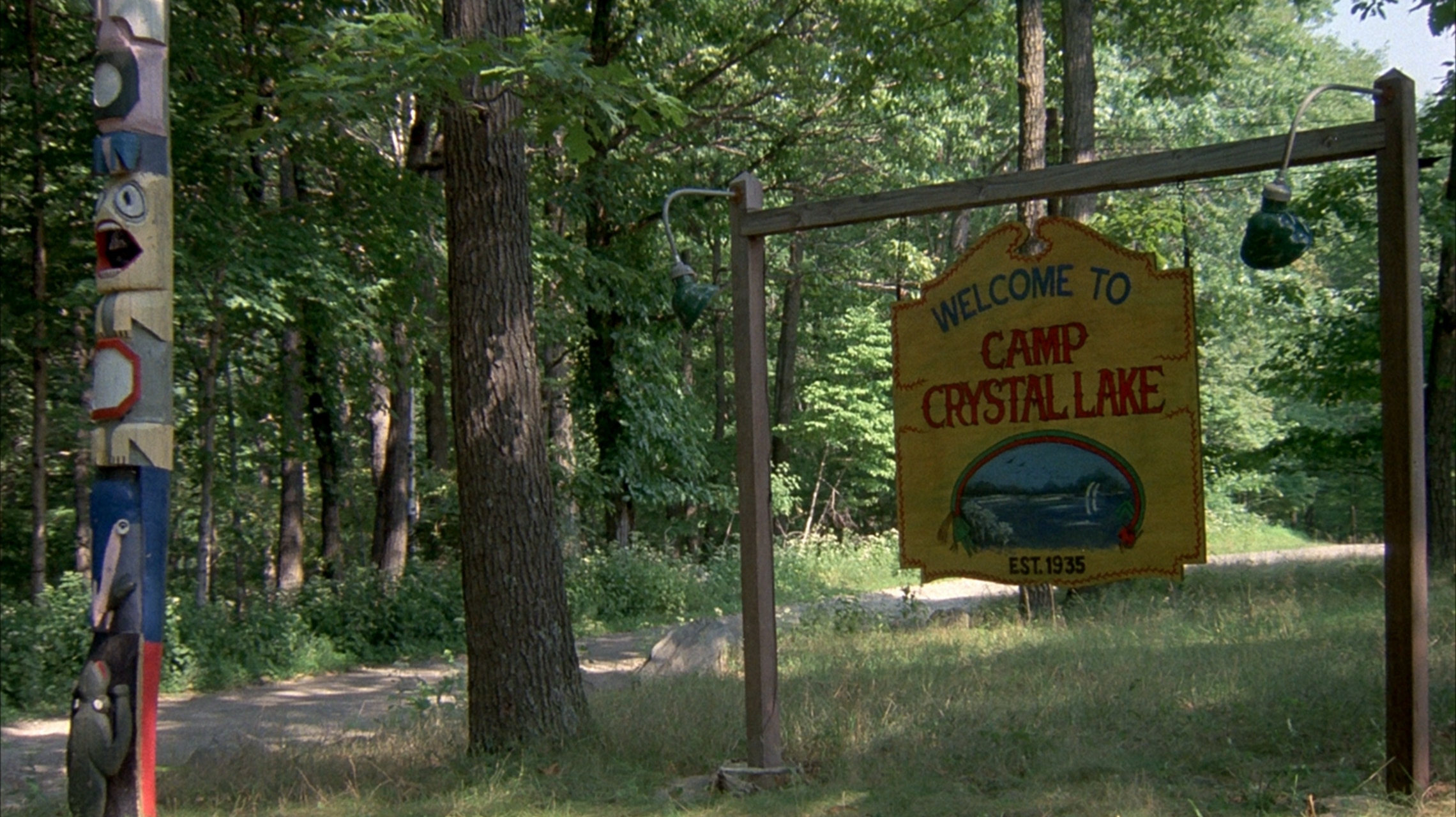
Next is the setting, which is probably the most subjective opinion of this list. I loved the suburban feeling of A Nightmare on Elm Street and Halloween, that could be because I live in a suburban area and it feels at home to me. Friday the 13th, on the other hand takes place in a camp site. I know it’s supposed to be isolated, but I find the area less interesting. In Halloween, with all of these houses you don’t know where Michael could be, where as with a very small campground you know exactly what building the mother will be at.

Alice Hardy (Character) - Comic Vine

Now we’ll get the so-called “final girl”. I’ll admit I couldn’t even remember Alice’s name and had to search it up to remember. Her character was bland, and I couldn’t remember what she was doing in the movie before her encounter with Ms. Vorhees. They should have killed her off in this movie, and I believe that would have made the ending much better. Laurie was a great main character in Halloween, who really took a little of damage to protect the children from Michael Myers, and Nancy from A Nightmare on Elm Street was a fearless fighter that you looked forward to seeing take on Freddy.

Being Retro: OCTOBER: WHO IS STRONGER... LAURIE STRODE or NANCY THOMPSON?

Despite these complaints, I still did enjoy the movie and want to see the sequels eventually. It just ranks as a good movie for me instead of one of my all-time favorites like Halloween and A Nightmare on Elm Street.

Scariest movie monster: Michael Myers or Freddy Krueger? | The Tylt

The Major Comedy Short Film Studios of the Early Sound Era

Up until around the 1960s, a movie theater experience was much more diverse than today. Not only were audiences treated a feature film, but also a diverse lineup including newsreels, travelogues, two-reel comedies, cartoons, and a musical (what we would think of as a music video). In this three-part series I will be looking at the key studios in three different areas: live-action comedy shorts, animated cartoons and serials. Today I look at the live action shorts, which were commonly called two-reelers, averaging at around 15-20 minutes.

Comedy shorts were very popular in early days of cinema, and most of the major comedians of the silent era started out doing short films: Charlie Chaplin, Buster Keaton, Harold Lloyd, Fatty Arbuckle, Mabel Normand. During the 1920s most of these key actors did the bulk of their work in features, and short films were often seen as mere appetizers to the main course of the features. Still, the top figures in short comedies were still household names, and often were used to get audiences to watch lesser B movies that played after the short. During the sound era, there were only a few key two-reel studios left. I will be looking at four of them: Mack Sennett, Educational Pictures, Hal Roach Studios and Columbia Pictures.

Mack Sennett

The Dentist (1932) HD - W.C. Fields - YouTube

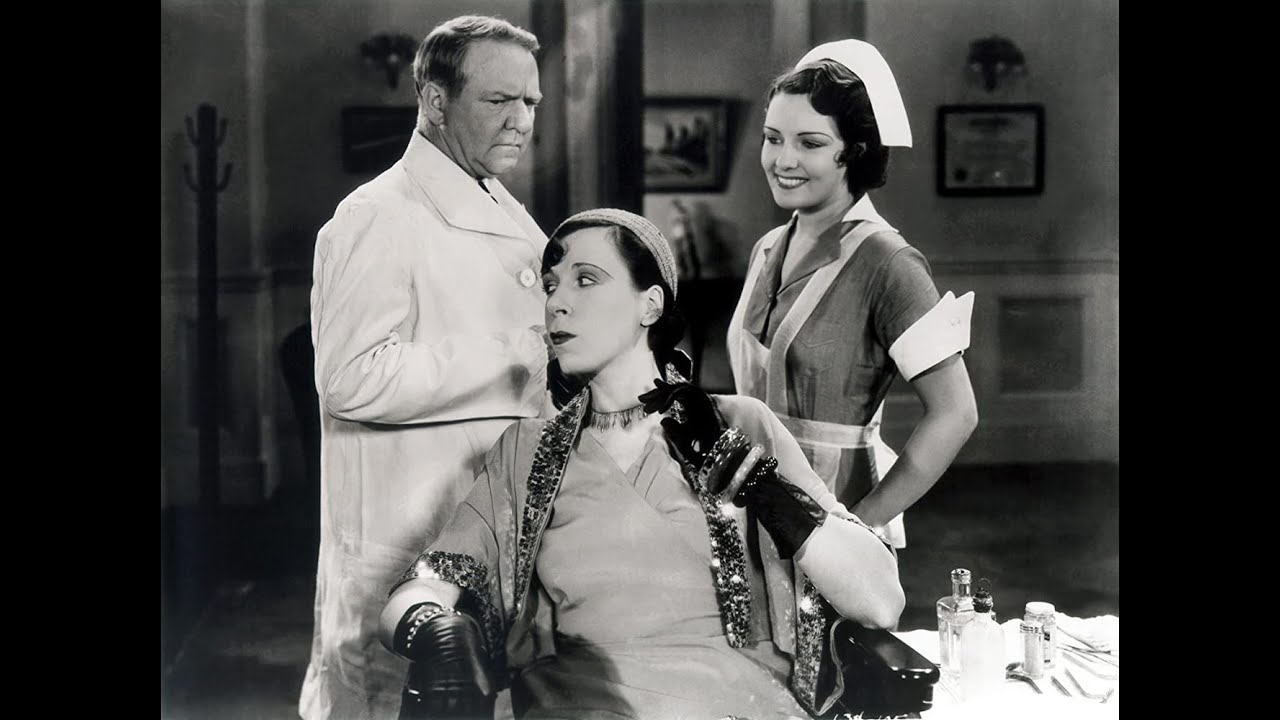
Mack Sennett was the top producer of comedy during the silent era. He had a great eye for discovering talent: Charlie Chaplin, Mabel Normand, Fatty Arbuckle, Andy Clyde and Harry Langdon all made their names working for Sennett. Unfortunately, he could not keep talent, and they often left him soon after they gained fame. When the sound era began, his significance was largely gone. The top star at his studio during the talkie era was Andy Clyde, starring in shorts distributed by Educational (not to be confused with the films Educational were themselves making). He also hired two-big name talents to produce a series of shorts under him: Bing Crosby and W.C. Fields. The Bing Crosby two-reelers were popular enough that they ended up being distributed by a major studio: Paramount. W.C. Fields soon followed with four shorts that were not successful at the time, but have been highly regarded in the decades since. These still did not save the studio from bankruptcy. In 1933, the Mack Sennett studio closed for good.

Educational Pictures

Buster Keaton giving directions in One Run Elmer (1935 ...

Educational Pictures was founded in 1916 with the goal of making instructional videos for school students. But they found themselves a niche in comedy, and decided to make it their bread-and-butter. In the silent era they had famous comedians Lupino Lane and Lloyd Hamilton working for them. In the 1930s they mainly became sort of a graveyard for previously famous silent comedians including Buster Keaton, Harry Langdon and Andy Clyde or people who would be stars in the future such as Joan Davis, Shirley Temple, Bob Hope, Imogene Coca and the Ritz Brothers. The films were distributed by 20th Century Fox. The studio’s work has a middle-ground reputation: it’s commonly accepted that Buster Keaton and Harry Langdon did their best sound work working for Educational, but still vastly inferior to their work in the silent era. In 1937 when Fox dropped their distribution of Educational’s shorts, they decided to drop out of the shorts department.

Hal Roach

Laurel and Hardy's “The Music Box” - Pop Off - Medium

In my opinion Hal Roach’s studio was the greatest two-reel comedy studio in history, and it’s not even a close competition. From 1915, when Hal Roach entered the comedy shorts field, to 1938, the films were produced with great quality. Rather than just relying on slapstick, there was an actual motivation and depth to the characters. Hal Roach had several talent during the prime of their careers. Harold Lloyd’s first starring comedies were with the Hal Roach studio. His first character was Willie Work, which I have not been able to found any footage of, so I’m not sure exactly what the character was like. He next played a Charlie Chaplin-clone called Lonesome Luke, before finding his greatest success as the Glasses character starting in 1917. In 1921, he moved into feature films and left the Hal Roach studio in 1923 to form his own production company. Roach was did not miss a beat; the enormously popular Our Gang comedies (probably more known by the name it went by on television: The Little Rascals) began shortly before, and the excellent Charley Chase comedies began shortly after Lloyd’s departure. In 1927 a chance pairing involving Stan Laurel and Oliver Hardy produced well-regarded comedies, and the decision was made to permanently turn them into a team. A distribution with deal MGM, the biggest of all the major studios, also began that year. When the sound era began, most studios had trouble adjusting. Hal Roach hit success right off the bat. Laurel and Hardy turned out to be as great speaking as in slapstick, and Charley Chase was a talented singer who could now show off his skill. It was feared that the Our Gang children would have a problem remembering their lines, but these turned out to be moot with the comedies become more popular than ever. The only real failure was an unsuccessful partnership with Harry Langdon.

Hal Roach also had a great supporting cast: Thelma Todd, Anita Garvin, Mae Busch, and Jimmy Finlayson. Todd was popular enough to have her own starring series. Hal Roach wanted to create a female Laurel and Hardy team, so he termed her up with ZaSu Pitts. When Pitts left Hal Roach, she was then paired with Patsy Kelly until Thelma Todd’s controversial death in 1935. As they say, all great things come to an end and Hal Roach wanted to stop making shorts and move into features. Laurel and Hardy had a successful period making features for Roach, but the Our Gang kids were not so lucky. One feature film was produced: General Spanky. It was a box-office failure and Hal Roach ended up selling the series outright to MGM where it continued until 1944. The greatest set of short film series were no more.

Columbia Pictures

The Final Years of Curly (of Three Stooges Fame) | Mental Floss

Columbia was the only major studio to be a significant player in two-reel comedies (all of the other major studios merely distributed to independents). In 1934 Harry Cohn hired Jules White to head the shorts department, and from the time Hal Roach left the market in 1938 to when Columbia released their last two-reeler in 1959, they had a monopoly. Jules White’s style has commonly been criticized for featuring too much violence and slapstick without much of a plot. I would mostly disagree with the criticisms for a few reasons.

1. Columbia, being the only company still making two-reel comedies in great numbers gave a lot of comedians a place to work: Buster Keaton, Harry Langdon, Andy Clyde and Charley Chase all found work there when Hal Roach and Educational stopped making short films.
2. They didn’t have much money to work with and made the best of what they could with limited resources.
3. The films were highly entertaining, and even if the plots and gags were ridiculous they were still amusing.

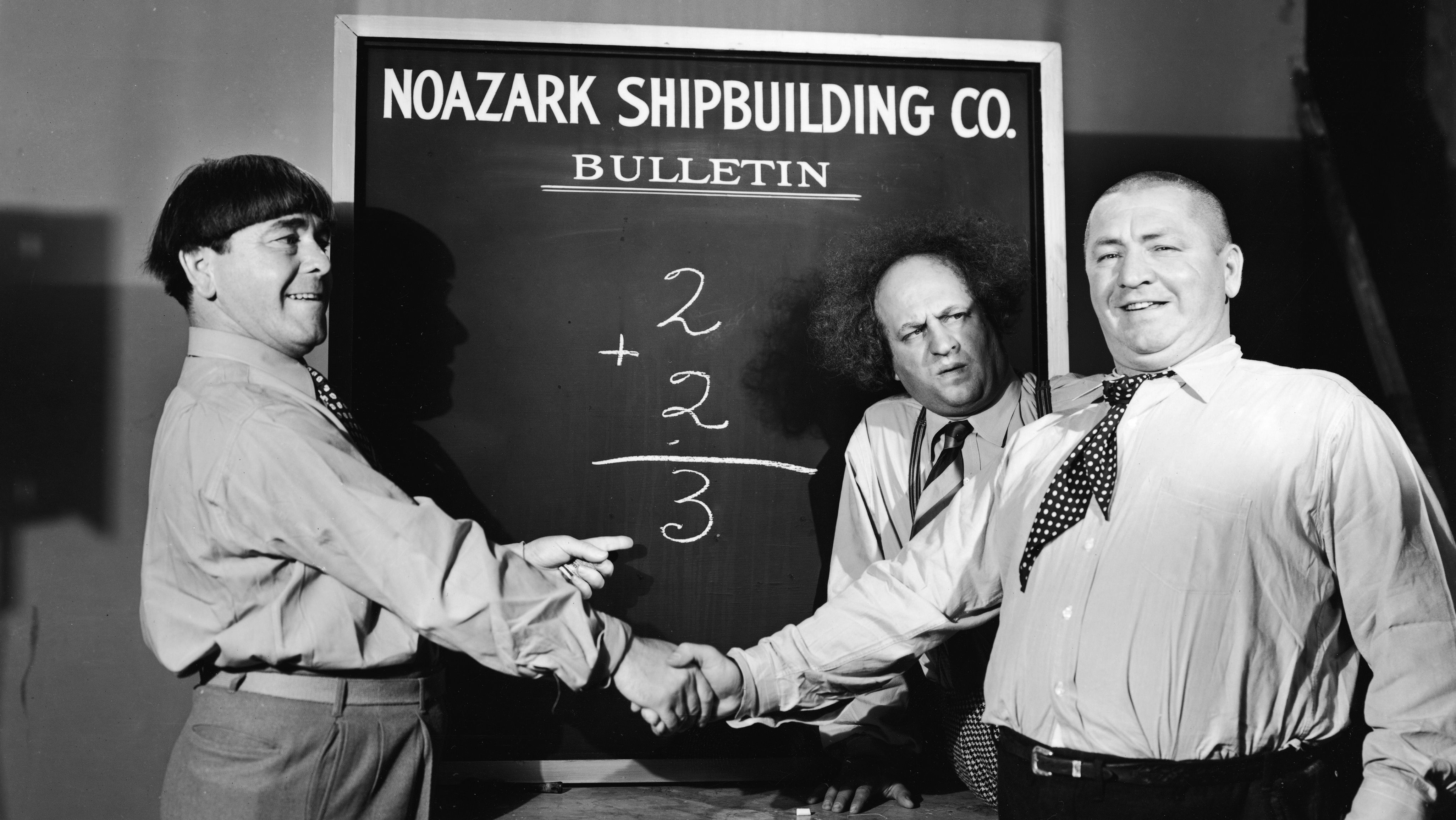
The most important act at the studio was The Three Stooges. After leaving Ted Healy and MGM in 1934, they signed a contract with Columbia that lasted almost a quarter century. The slapstick violence fit them perfectly and was cartoonish in nature. During the 1950s movie theater attendance dropped dramatically due to the rise of television. The save costs several movie theaters dropped the shorts and and only went with features. With not much of a future left, Columbia stopped production on short comedies in 1957, but they produced enough that the last ones were released in 1959.